
Key takeaways
- For NSOs, the spread at exercise is generally taxed as ordinary income and, for employees, reported on Form W-2.
- ISOs generally do not create regular taxable income at exercise, but the spread may count toward the alternative minimum tax (AMT).
- ISO shares sold before the later of two years from grant and one year from exercise are generally a "disqualifying disposition," and part of the gain is taxed as ordinary income.
- Exercising options can require cash for the exercise price and for potential taxes, so liquidity and concentration deserve careful thought.
- Year-end timing can affect which tax year income or AMT falls into, and modeling scenarios with a tax professional may help.
Stock options can be a meaningful part of compensation at companies of every size and industry. The two main types, incentive stock options (ISOs) and nonqualified stock options (NSOs), can look alike on a grant agreement but are taxed very differently.
As the year winds down, exercise timing can affect your tax picture for 2026 and beyond. This educational overview covers key differences and decision points at a high level; the appropriate approach depends on your plan documents, finances, and goals.
The Basics: What an Option Gives You
A stock option is the right, but not the obligation, to buy company shares at a set price (the exercise or strike price) for a set period. When the market value of the stock is above the exercise price, the difference is often called the “spread.” What happens to that spread for tax purposes depends on whether you hold ISOs or NSOs.
How NSOs Are Taxed
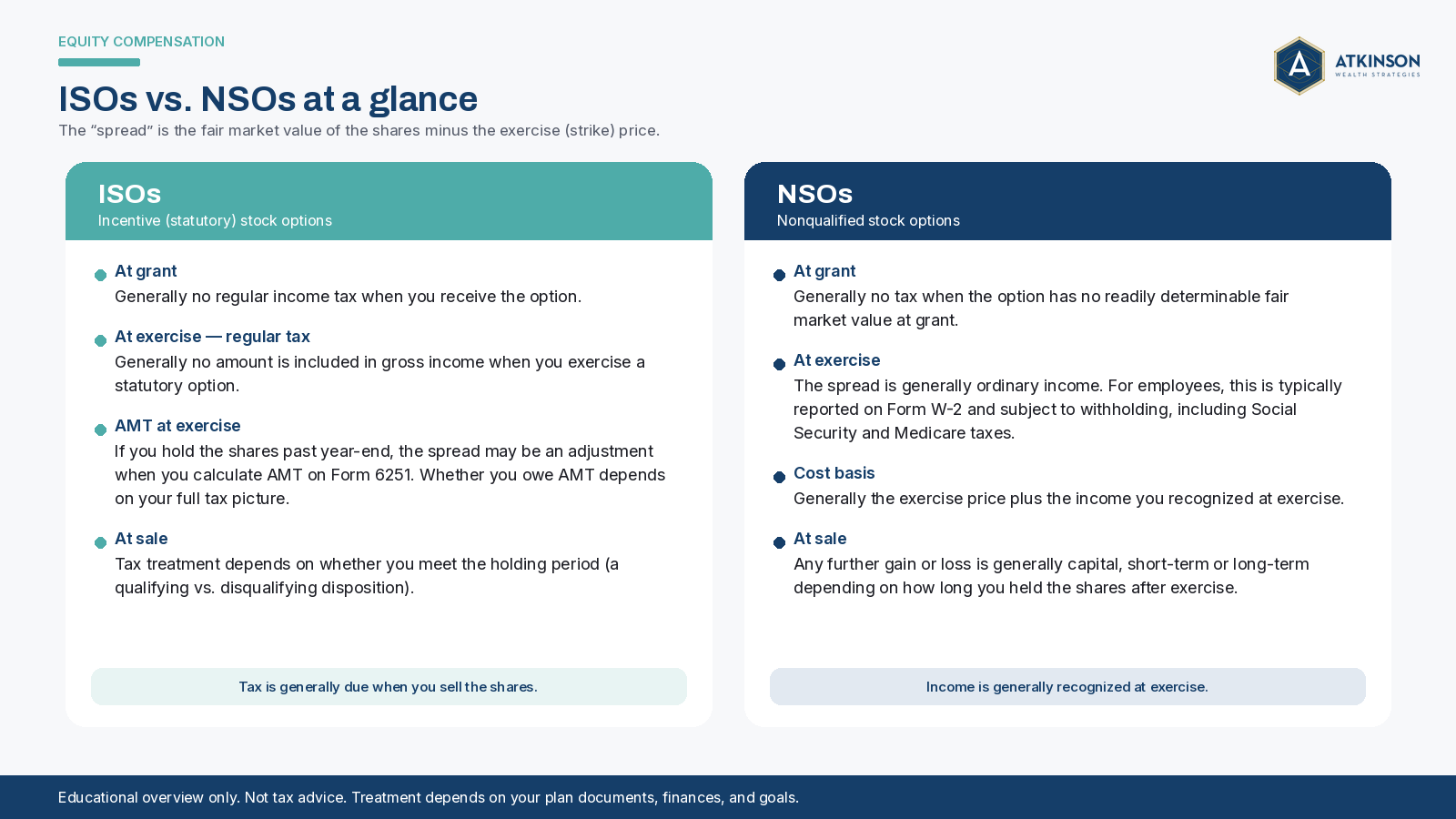
According to IRS Topic No. 427, most NSOs don’t have a readily determinable fair market value when granted, so there is generally no tax at grant. Instead:
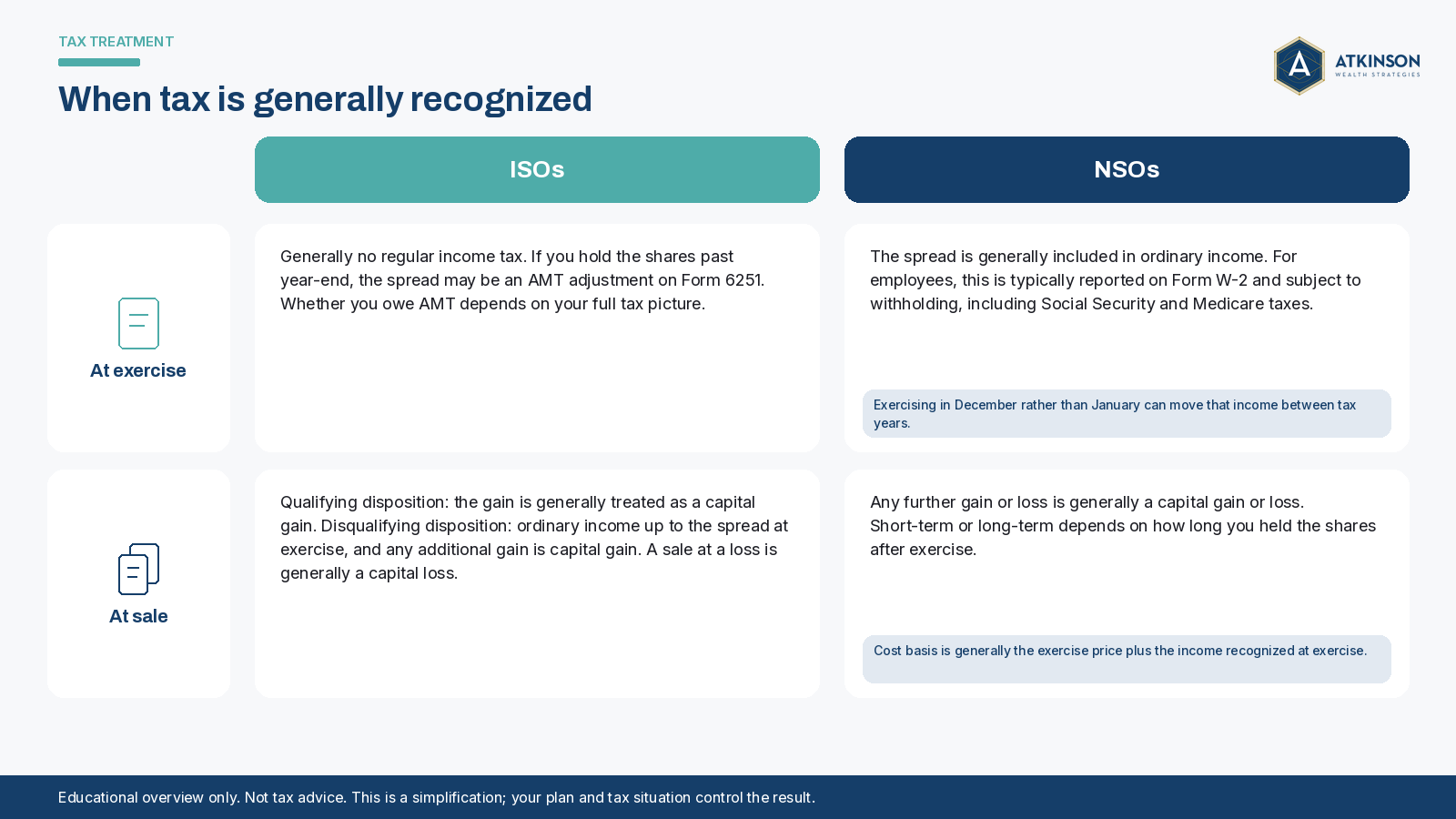
- At exercise: The fair market value of the shares minus the price you pay is generally included in income. For employees, this is typically reported on Form W-2 and subject to withholding, including Social Security and Medicare taxes.
- Cost basis: Generally, your basis is the exercise price plus the income you recognized at exercise.
- At sale: Any further gain or loss is generally a capital gain or loss, short-term or long-term depending on how long you held the shares after exercise.
Because NSO income is recognized at exercise, choosing whether to exercise in December or January can move that income between tax years. Learn more on our nonqualified stock options page.
How ISOs Are Taxed
Regular income tax
ISOs are “statutory” stock options. The IRS notes that you generally don’t include any amount in gross income when you receive or exercise a statutory option. Tax is generally due when you sell the shares, and how much depends on whether you meet the holding period requirements.
AMT considerations
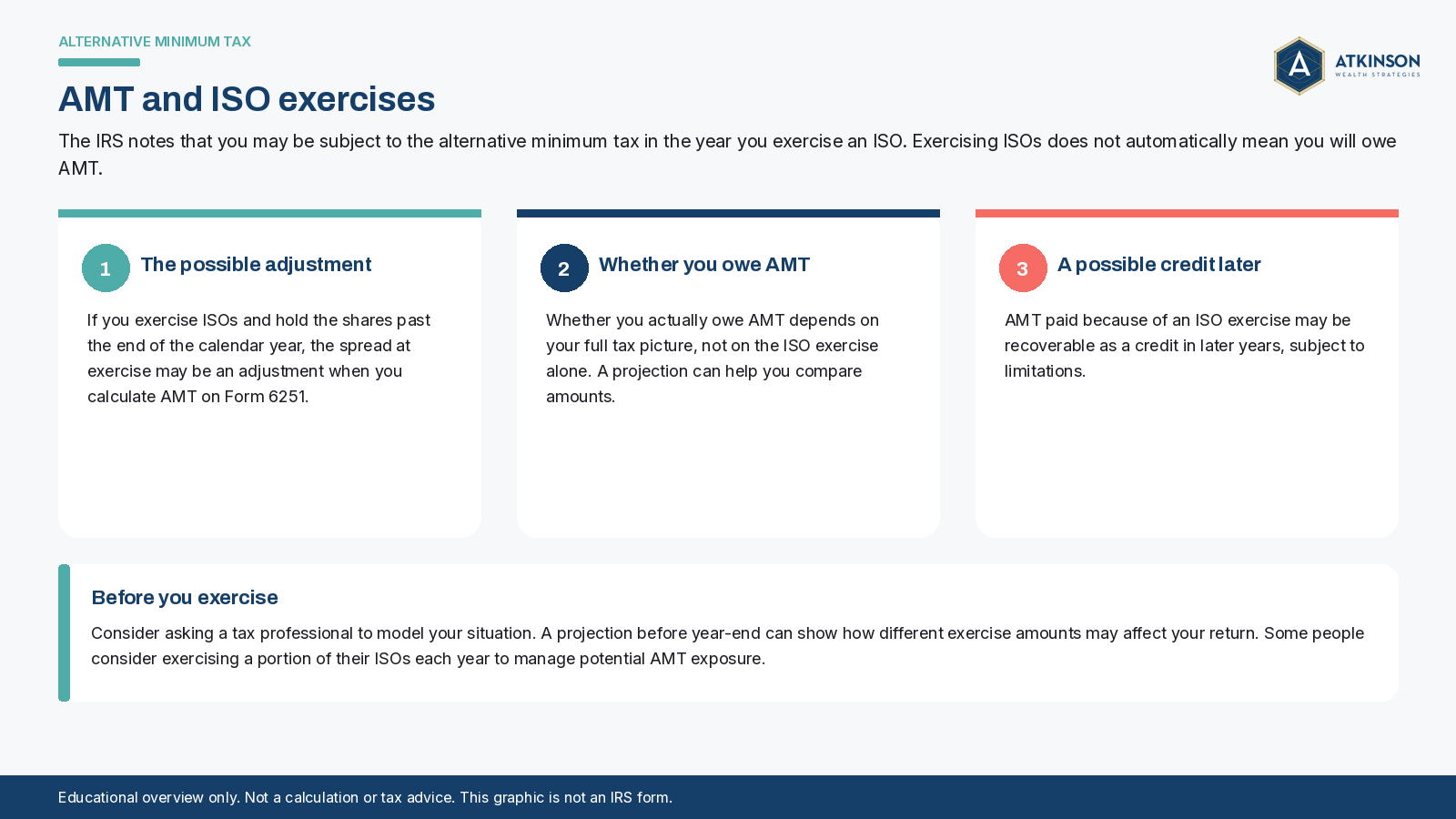
The IRS also notes that you may be subject to the alternative minimum tax in the year you exercise an ISO. In general, if you exercise ISOs and hold the shares past the end of the calendar year, the spread at exercise may be an adjustment when you calculate AMT on Form 6251. Whether you actually owe AMT depends on your full tax picture.
AMT paid because of an ISO exercise may be recoverable as a credit in later years, subject to limitations. Consider asking a tax professional to model your situation before you exercise.
Qualifying vs. disqualifying dispositions
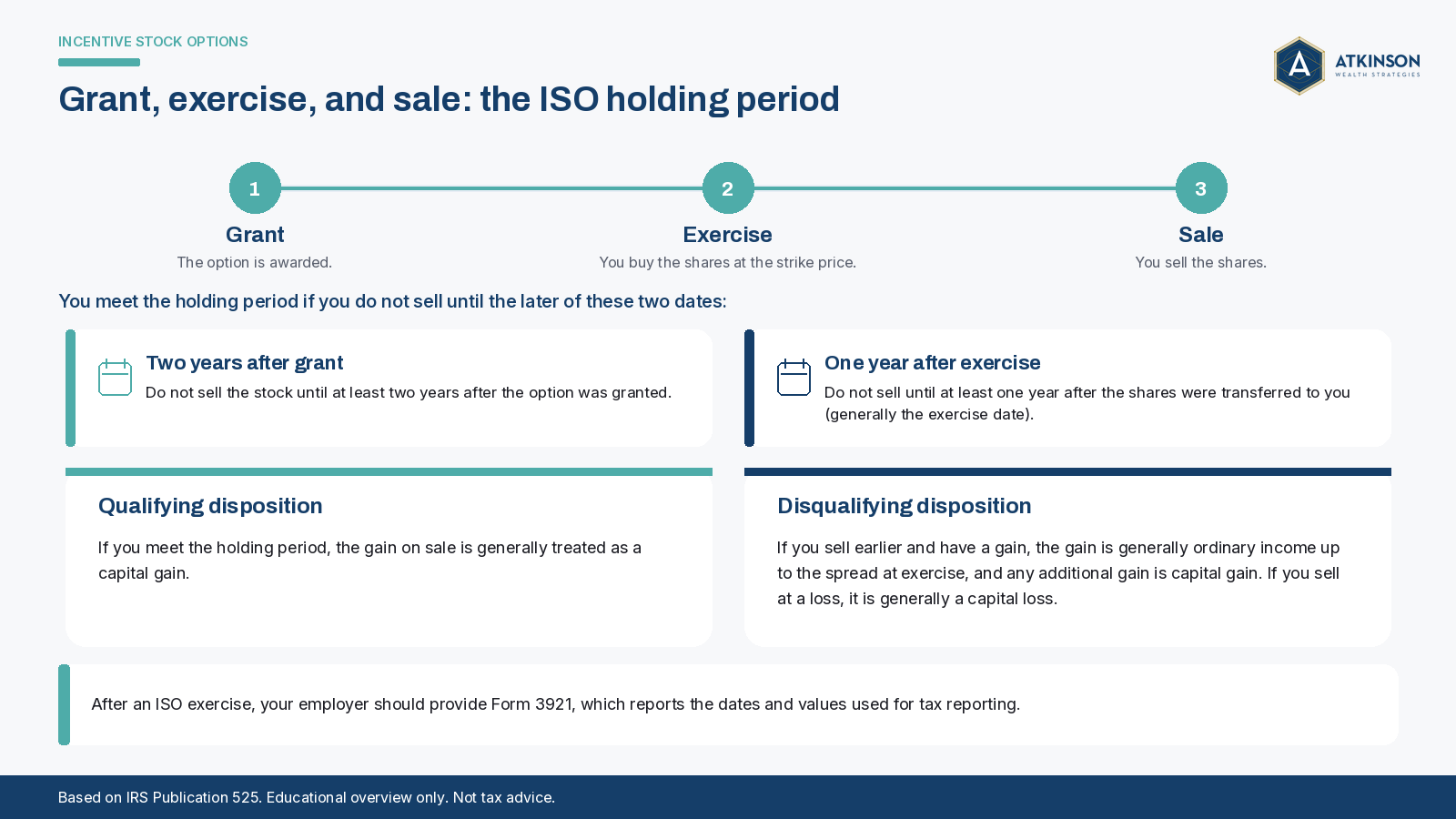
According to IRS Publication 525, you meet the holding period requirement if you don’t sell the stock until the later of:
- one year after the shares were transferred to you (generally the exercise date), or
- two years after the option was granted.
Qualifying disposition: If you meet the holding period, the gain on sale is generally treated as a capital gain.
Disqualifying disposition: If you sell earlier and have a gain, Publication 525 explains that the gain is generally ordinary income up to the spread at exercise, and any additional gain is capital gain. If you sell at a loss, it is generally a capital loss.
For more, see our page on incentive stock options. After an ISO exercise, your employer should provide Form 3921, which reports the dates and values used for tax reporting.
Key Decision Points Before Year-End
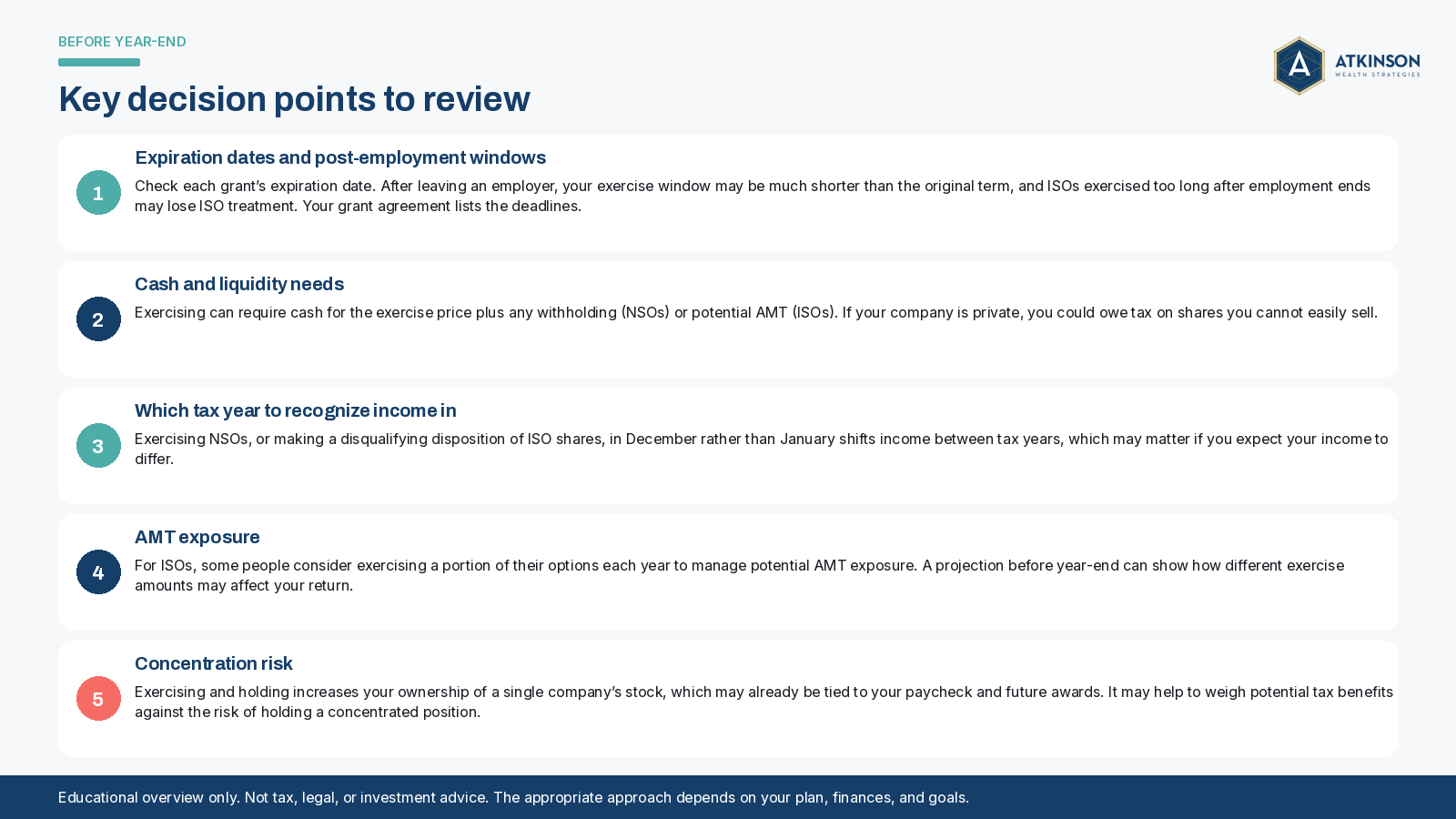
1. Expiration dates and post-employment windows
Check each grant’s expiration date. After leaving an employer, your exercise window may be much shorter than the original term, and ISOs exercised too long after employment ends may lose ISO treatment. Your grant agreement lists the deadlines.
2. Cash and liquidity needs
Exercising can require cash for the exercise price plus any withholding (NSOs) or potential AMT (ISOs). If your company is private, you could owe tax on shares you can’t easily sell. Consider how an exercise fits with your reserves and near-term goals.
3. Which tax year to recognize income in
Exercising NSOs, or making a disqualifying disposition of ISO shares, in December rather than January shifts income between tax years, which may matter if you expect your income to differ.
4. AMT exposure
For ISOs, some people consider exercising a portion of their options each year to manage potential AMT exposure. A projection before December 31 can show how different exercise amounts may affect your 2026 return.
5. Concentration risk
Exercising and holding increases your ownership of a single company’s stock, which may already be tied to your paycheck and future awards. It may help to weigh potential tax benefits against the risk of holding a concentrated position.
Exercise Strategies at a High Level
Common approaches include the following. Each has trade-offs, and none is right for everyone.
- Exercise and sell: Exercising and selling right away, sometimes through a cashless exercise, converts options to cash. For ISOs, this is generally a disqualifying disposition.
- Exercise and hold: This may set up a qualifying disposition (ISOs) or long-term capital gains treatment on later appreciation, but it requires cash, carries market risk, and for ISOs may trigger AMT.
- Staged or partial exercises: Spreading exercises over several years may help manage annual income or AMT exposure.
- Waiting: Holding off preserves cash and flexibility, but options can expire, and future tax treatment depends on the share price at the time of exercise.
These choices may be easier to evaluate when they are coordinated with your broader independent financial planning and with guidance from a tax professional.
ISO and NSO decisions often involve taxes, cash flow, and concentration risk all at once. If you’d like help organizing your grants, deadlines, and questions for your tax professional, you’re welcome to request a complimentary wealth review. It’s a no-obligation conversation about how your stock options fit with your Goals, Values, and Aspirations™.
Sources
Frequently asked questions
What is the main tax difference between ISOs and NSOs?
With NSOs, the spread at exercise is generally taxed as ordinary income. With ISOs, there is generally no regular income tax at exercise, but the spread may affect AMT, and the treatment at sale depends on whether the holding period requirements are met.
Does exercising ISOs always trigger AMT?
No. The spread from an ISO exercise may be an AMT adjustment if you hold the shares past year-end, but whether you owe AMT depends on your overall income and tax situation.
What is a disqualifying disposition?
A sale of ISO (or qualified ESPP) shares before meeting the holding period requirements, which generally causes part of the gain to be taxed as ordinary income.
Can I exercise options without paying cash up front?
Some plans offer cashless or net exercise features, especially for publicly traded shares. Check with your plan administrator.