

We get a lot of questions from clients and prospective clients about municipal bonds: What exactly is a muni? How do they work? Are they really tax-free? Should they be in my portfolio? So we decided to put together a post that walks through what they are and how they work, like a short class. This guide covers the building blocks. Whether munis belong in your portfolio depends on your tax bracket, where you live, your goals, and how they fit within your overall financial plan, which is a conversation to have with your advisor.
A municipal bond, or muni, is an IOU from a state, city, school district, or other public issuer.
Every example here is hypothetical and is for teaching only.
Key Takeaways
- A municipal bond is an IOU from a state, city, school district, or other public issuer. You lend money, the issuer typically pays you interest, and if it pays as promised, you get your principal back at maturity.
- Most munis fall into two families: general obligation bonds, usually backed by the issuer’s taxing power, and revenue bonds, backed by a specific source of money such as water bills or tolls.
- Interest on many munis is exempt from federal income tax, but munis are not tax-free in every way. Gains when you sell, market discount, the AMT on some bonds, Social Security taxation, and Medicare premiums can all still be affected.
- Where you live matters. Washington has no state income tax, so in-state versus out-of-state makes no difference to how your muni interest is taxed there. California generally exempts interest on California munis and taxes interest on munis from other states.
- Taxable-equivalent yield helps you compare a tax-exempt bond with a taxable one, but it is only a starting point. Munis still carry interest-rate, credit, call, liquidity, inflation, tax-law, and concentration risk.
Lesson 1: What Is a Municipal Bond?
Let’s start with the big idea. Cities, states, and school districts need money to build things: schools, roads, water systems, hospitals. Usually they don’t pay for those projects all at once. They borrow.
One way they borrow is by selling bonds to investors like you.
Think of a muni like an IOU from your city. You hand over money today. The city promises to pay you interest along the way and to pay you back on a set date in the future.
A few terms to know:
- Issuer. The government or public agency that borrows the money and owes it back.
- Bondholder. You, the investor who lent the money.
- Municipal bond, or “muni.” A bond issued by a state, city, county, school district, or other public entity.
The SEC’s Investor.gov explains that interest on munis is often, but not always, exempt from federal income tax. It may also be exempt from state and local tax if you live in the state that issued the bond.
One important point before we move on. A muni is not a U.S. Treasury bond, and it’s not a bank CD. How safe it is depends on who issued it and where the money to repay it comes from. The word “municipal” by itself doesn’t promise anything.
What this means for you: When you buy a muni, you’re a lender to a public issuer. Your interest and your money back depend on that issuer keeping its promise.
Lesson 2: How a Municipal Bond Works
Now let’s look at the moving parts. Every bond has three basic terms. Once you know them, you can read almost any bond description.
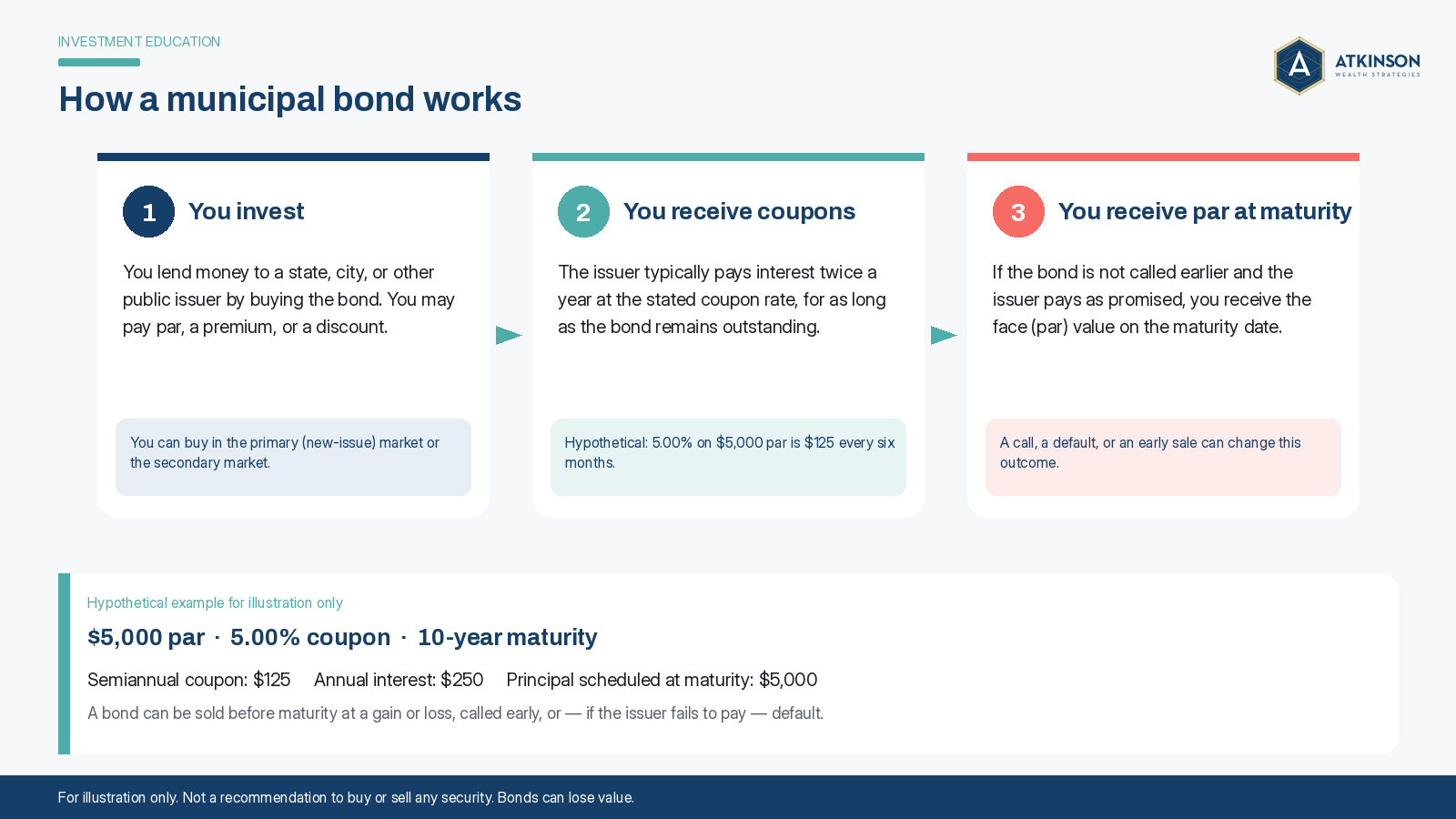
- Par value (or face value). The amount the issuer promises to repay at the end. For munis, that’s often $5,000 per bond.
- Coupon. The interest rate the bond pays, stated as a yearly percentage of par. Most munis pay interest twice a year.
- Maturity. The date the issuer is scheduled to pay back par. That could be one year away or 30.
Let’s work an example.
Hypothetical example for illustration only. Say you buy one muni with a $5,000 par value, a 5.00% coupon, and a 10-year maturity.
- Step 1: Find the yearly interest. $5,000 × 5.00% = $250 per year.
- Step 2: Split it into two payments. $250 ÷ 2 = $125 every six months.
- Step 3: At maturity, if the issuer pays as promised, you get your $5,000 back.
Simple enough. But real bonds have a few wrinkles.
Price isn’t always par. You might pay more than par (a premium) or less than par (a discount), depending on interest rates and demand when you buy.
Some bonds can be “called.” A callable bond lets the issuer pay you back early, often after about 10 years. Picture a homeowner refinancing a mortgage when rates drop. Issuers do the same thing. If your bond is called, you get your money back sooner than planned, and you may have to reinvest it at a lower rate. That’s called reinvestment risk.
There are two places to buy. The primary market is where brand-new bonds are sold. The secondary market is where investors buy and sell bonds that already exist. Prices in the secondary market move up and down every day.
There’s a free place to do your homework. The Municipal Securities Rulemaking Board runs a website called EMMA (emma.msrb.org). The SEC designated it in 2009 as the official home for municipal bond disclosures. On EMMA you can read a bond’s official statement (think of it as the bond’s prospectus), its ongoing financial updates, and its recent trade prices. Investor.gov notes that neither the SEC nor the MSRB reviews those documents before they’re posted, so read them with a critical eye.
What this means for you: Know the par, coupon, maturity, and call date before you buy. And know that your actual result depends on the price you pay, whether the bond is called, and whether you hold it to the end.
Lesson 3: The Two Main Families, GO vs. Revenue Bonds
Here’s the key question for any bond: where does the money to pay me come from? For munis, the answer usually puts a bond into one of two families. Both Investor.gov and the MSRB describe them.
General obligation (GO) bonds
These are typically backed by the issuer’s taxing power. You’ll often hear this called the issuer’s “full faith and credit.” The issuer pays you from its general funds, which can include property taxes and other taxes.
A simple way to picture it: a GO bond is like a household that promises to pay a loan out of its whole paycheck. One caution, though. Some GO bonds come with limits on how much the issuer can raise taxes, so not every GO is backed the same way.
Revenue bonds
These are paid from one specific source of money. That might be water and sewer bills, bridge tolls, airport fees, or transit fares.
Picture a toll bridge. The bridge was built with borrowed money, and the tolls pay back the loan. If fewer cars cross than expected, there’s less money to pay bondholders. And in most cases, the bondholders can’t turn to the city’s taxpayers to make up the difference.
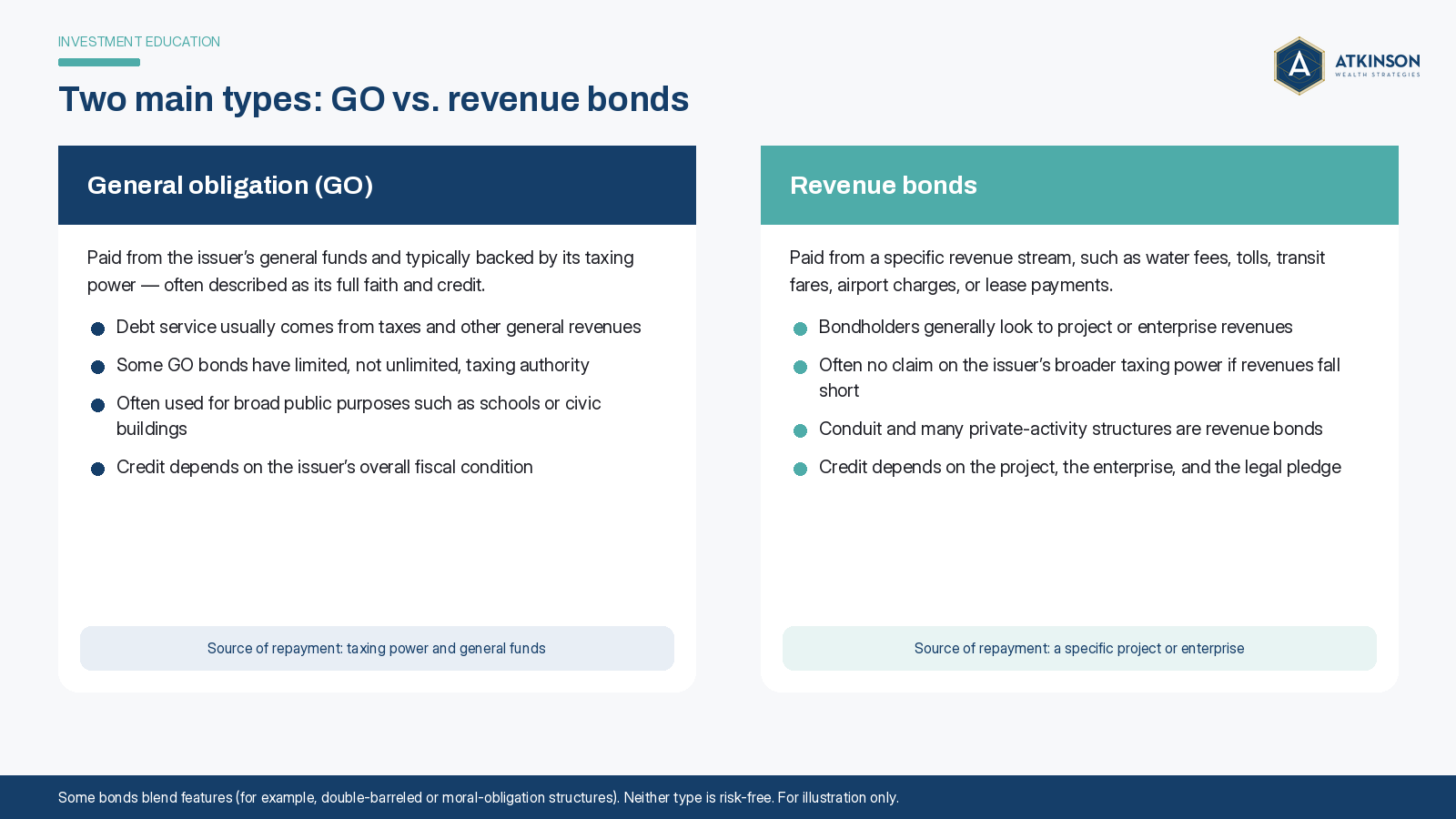
Some bonds blend the two. For example, a “double-barreled” bond is backed by a specific revenue source and by the issuer’s general credit as a backup. The official statement tells you exactly what’s backing a bond.
What this means for you: Neither family is automatically safer. A GO issuer can hit budget trouble. A revenue project can bring in less money than expected. Always ask, “Who pays me, and from what?”
Lesson 4: Other Types You May Hear About
You now know the two big families. Here’s a quick vocabulary list of other terms you might run into.
- Taxable munis. Not every muni is tax-exempt. If a project doesn’t meet federal tax rules, the issuer may sell a taxable municipal bond. The interest is generally subject to federal income tax. “Municipal” describes who issued it, not how it’s taxed.
- Private activity bonds (PABs). These help pay for projects that benefit a private user, such as some airport facilities or certain hospitals. Interest on a “qualified” PAB can be exempt from regular federal income tax. But IRS Publication 550 and the Form 6251 instructions explain that interest on many PABs issued after August 7, 1986, counts toward the alternative minimum tax (AMT), a separate tax calculation some people must run. There are exceptions, including qualified 501(c)(3) bonds and bonds issued in 2009 and 2010.
- Pre-refunded bonds. Sometimes an issuer sells new bonds and sets the money aside in an escrow account, often in Treasury securities, to pay off older bonds at their call date or maturity. The older bonds are then called “pre-refunded.” Their safety often rests more on that escrow than on the original issuer, but you should still read the documents.
- Zero-coupon munis. These pay no interest along the way. You buy them at a deep discount and, if the issuer pays as promised, collect par at maturity. FINRA notes that zeros can be especially sensitive to changes in interest rates. For a tax-exempt muni zero, the built-in growth is generally treated as tax-exempt interest, unlike many taxable zeros.
- Build America Bonds (BABs). Created by Congress in 2009, these were taxable munis that came with a federal tax credit or a federal subsidy paid to the issuer. They could only be issued in 2009 and 2010, but the MSRB notes some still trade today.
What this means for you: Don’t assume. Check whether a bond is tax-exempt, taxable, or subject to the AMT before you compare it to anything else.
Lesson 5: How Munis Are Taxed at the Federal Level
This is the lesson most people came for. Let’s take it one piece at a time.
Piece 1: The interest. Interest on munis that meet federal rules is generally excluded from federal taxable income. That’s the “tax-exempt” feature. You still report it on your tax return. It just isn’t added to your taxable income.
Piece 2: Selling before maturity. Here’s where “tax-free” gets misleading. If you sell a muni for more than you paid (after certain adjustments), the gain is generally a taxable capital gain. If you sell for less, you may have a capital loss. The tax exemption covers the interest, not the profit from a sale.
Piece 3: Buying at a discount. If you buy a muni on the secondary market for less than its value on paper, that gap may be market discount. Publication 550 says market discount on a tax-exempt bond is not tax-exempt. When you sell or redeem the bond, it’s generally taxed as ordinary income.
The de minimis rule
There’s a small-discount exception called the de minimis rule. If the discount is less than 0.25% of par multiplied by the number of full years left until maturity, it’s generally treated as zero, and any gain is typically treated as a capital gain instead.
Let’s work it out. Hypothetical example for illustration only.
- Step 1: Start with a $5,000 bond that has 10 full years left.
- Step 2: Find the threshold. 0.25% × $5,000 × 10 = $125.
- Step 3: Compare. If you pay $4,900, your discount is $100. That’s under $125, so it’s generally de minimis. If you pay $4,860, your discount is $140. That’s over $125, so it’s generally market discount.
Real calculations can be more detailed than this, so let your tax professional run the actual numbers.
Piece 4: The AMT. As we covered in Lesson 4, interest on some private activity bonds counts toward the alternative minimum tax. If you could be subject to the AMT, this matters.
Social Security and Medicare
Even though muni interest isn’t taxable income, it still counts in some other formulas.
- Social Security. To decide how much of your Social Security benefits are taxable, the IRS uses a figure often called “combined income.” IRS Publication 915 includes tax-exempt interest, “such as interest on municipal bonds,” in that calculation.
- Medicare premiums. Higher-income Medicare enrollees pay an extra amount on Part B and Part D premiums, called IRMAA. The income test adds tax-exempt interest back in (20 CFR 418.1010; SSA Handbook § 2501). It’s generally based on your tax return from two years earlier.
What this means for you: Muni interest can be federally tax-exempt and still affect your taxes on Social Security, your Medicare premiums, and your AMT. If you’re retired or close to it, look at the whole picture.
Lesson 6: State Taxes, a Washington vs. California Case Study
Now let’s add state taxes. Each state sets its own rules, and Washington and California are a great side-by-side lesson because they’re so different. Let’s meet two hypothetical students.
Hypothetical example for illustration only. Alex lives in Washington. Jordan lives in California. Each owns two munis: one issued in their own state and one issued in another state.
Alex in Washington
- Step 1: Does Washington have a personal income tax? No.
- Step 2: So is Alex’s in-state muni interest taxed by Washington? No.
- Step 3: What about the out-of-state muni? Also no. With no state income tax, there’s nothing to exempt.
So for Alex, the “buy in-state for the tax break” idea doesn’t change anything at the state level.
There’s one twist. Washington does have a capital gains excise tax on certain long-term gains. The Washington Department of Revenue says gains on stocks and bonds are allocated to Washington if you’re domiciled there when you sell. For tax year 2026, the standard deduction is $290,000. Taxable gains are taxed at 7% on the first $1 million and 9.9% on amounts above $1 million (Department of Revenue notice, June 30, 2025).
So if Alex sells bonds at a large long-term gain, that gain could be subject to this tax. The interest Alex earns is not. Interest isn’t a capital gain.
Jordan in California
- Step 1: Does California have a personal income tax? Yes, and it’s among the highest in the country. The Franchise Tax Board’s 2025 rate schedules top out at 12.3%. An extra 1% Behavioral Health Services Tax applies to taxable income over $1 million (2026 Form 540-ES instructions), for a combined 13.3% at that level.
- Step 2: Is Jordan’s California muni interest taxed by California? Generally no. California generally doesn’t tax interest on California municipal bonds.
- Step 3: What about the out-of-state muni? Generally yes. FTB Publication 1001 says California taxes interest from other states’ bonds, even when it’s federally tax-exempt.
One extra note for Jordan. If Jordan owns a muni mutual fund instead of individual bonds, Publication 1001 says the payouts generally get California’s exemption only if at least 50% of the fund’s assets would be California-exempt. A national muni fund may not qualify.
And if Jordan sells a bond at a gain? California generally taxes capital gains as regular income, with no special lower rate.
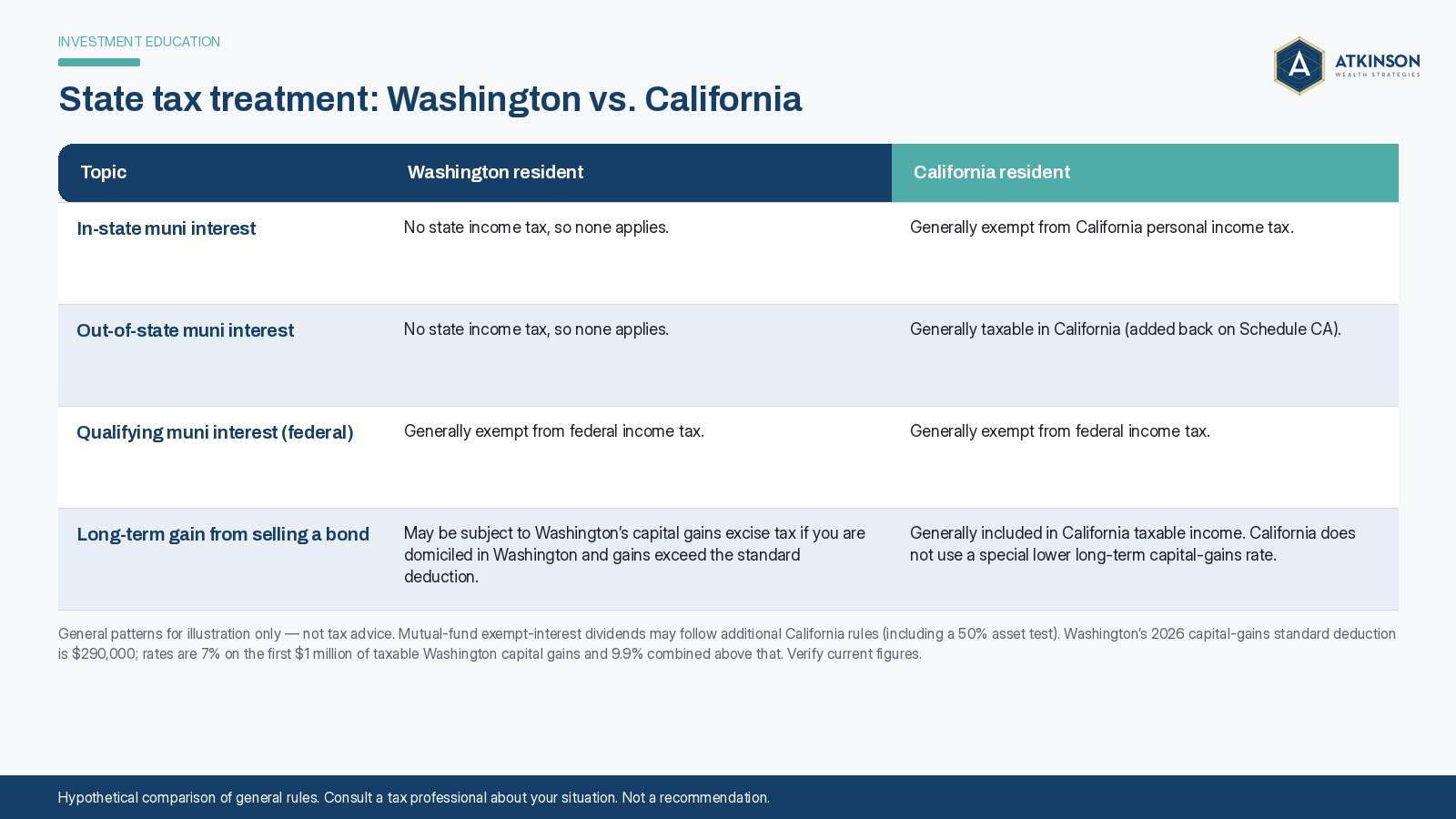
What this means for you: Where you live can matter as much as what you buy. In a no-income-tax state like Washington, in-state versus out-of-state doesn’t change your state tax on interest. In a high-tax state like California, it can make a real difference.
Lesson 7: Taxable-Equivalent Yield, Comparing Apples to Apples
Here’s the problem this lesson solves. Say a muni pays 5.00% tax-free and a corporate bond pays 7.00%, fully taxable. Which pays you more after taxes? You can’t tell by looking. You need to put them on the same footing.
That’s what taxable-equivalent yield does. It tells you what a taxable bond would need to pay to match the muni after taxes. This is also often called tax-equivalent yield.
The taxable-equivalent yield formula
Taxable-equivalent yield = tax-exempt yield ÷ (1 − your tax rate)
Your “tax rate” here is your marginal rate, the rate you’d pay on one more dollar of income. If state tax applies, add it in. (We’ll assume you can’t deduct the state tax on your federal return, which is common because of the federal cap on that deduction.)
Let’s work three problems. Hypothetical example for illustration only. These rates are assumptions, not quotes, projections, or recommendations. Each uses a 5.00% tax-exempt muni and an assumed 32% federal rate.
Problem 1: Alex in Washington
- Step 1: Find the tax rate. 32% federal + 0% state = 32%.
- Step 2: Subtract from 1. 1 − 0.32 = 0.68.
- Step 3: Divide. 5.00% ÷ 0.68 = 7.35%.
Answer: A taxable bond would need to yield about 7.35% to match Alex’s muni after taxes.
Problem 2: Jordan in California, buying a California muni
Let’s assume Jordan is in California’s 9.3% bracket.
- Step 1: Find the tax rate. 32% federal + 9.3% state = 41.3%.
- Step 2: Subtract from 1. 1 − 0.413 = 0.587.
- Step 3: Divide. 5.00% ÷ 0.587 = 8.52%.
Answer: Because Jordan’s California muni avoids both federal and state tax, a taxable bond would need about 8.52% to keep up.
Problem 3: Jordan in California, buying an out-of-state muni
Now the interest is still federally tax-exempt, but California taxes it.
- Step 1: Find what Jordan keeps after California tax. 5.00% × (1 − 0.093) = 4.535%.
- Step 2: Use the same 0.587 from Problem 2, because a fully taxable bond would face both taxes.
- Step 3: Divide. 4.535% ÷ 0.587 = 7.73%.
Answer: The same 5.00% muni is worth less to Jordan when it comes from out of state, about 7.73% instead of 8.52%.
The chart below runs the same idea at three assumed federal rates. It compares a federal-only calculation, like Alex’s, with a California resident in the top combined 13.3% bracket.

Before we leave this lesson, a few cautions. Taxable-equivalent yield doesn’t account for differences in credit quality, call features, maturity, or how easy a bond is to sell. It ignores the Social Security and Medicare effects from Lesson 5. Comparing against Treasury bonds is a little different, because California doesn’t tax Treasury interest. And inside an IRA or 401(k), the tax exemption generally adds little or no value, because those accounts are already tax-advantaged (traditional or Roth).
What this means for you: The higher your tax bracket, and the higher your state tax, the more a tax exemption can be worth. But it’s one input, not the whole decision.
Lesson 8: The Risks
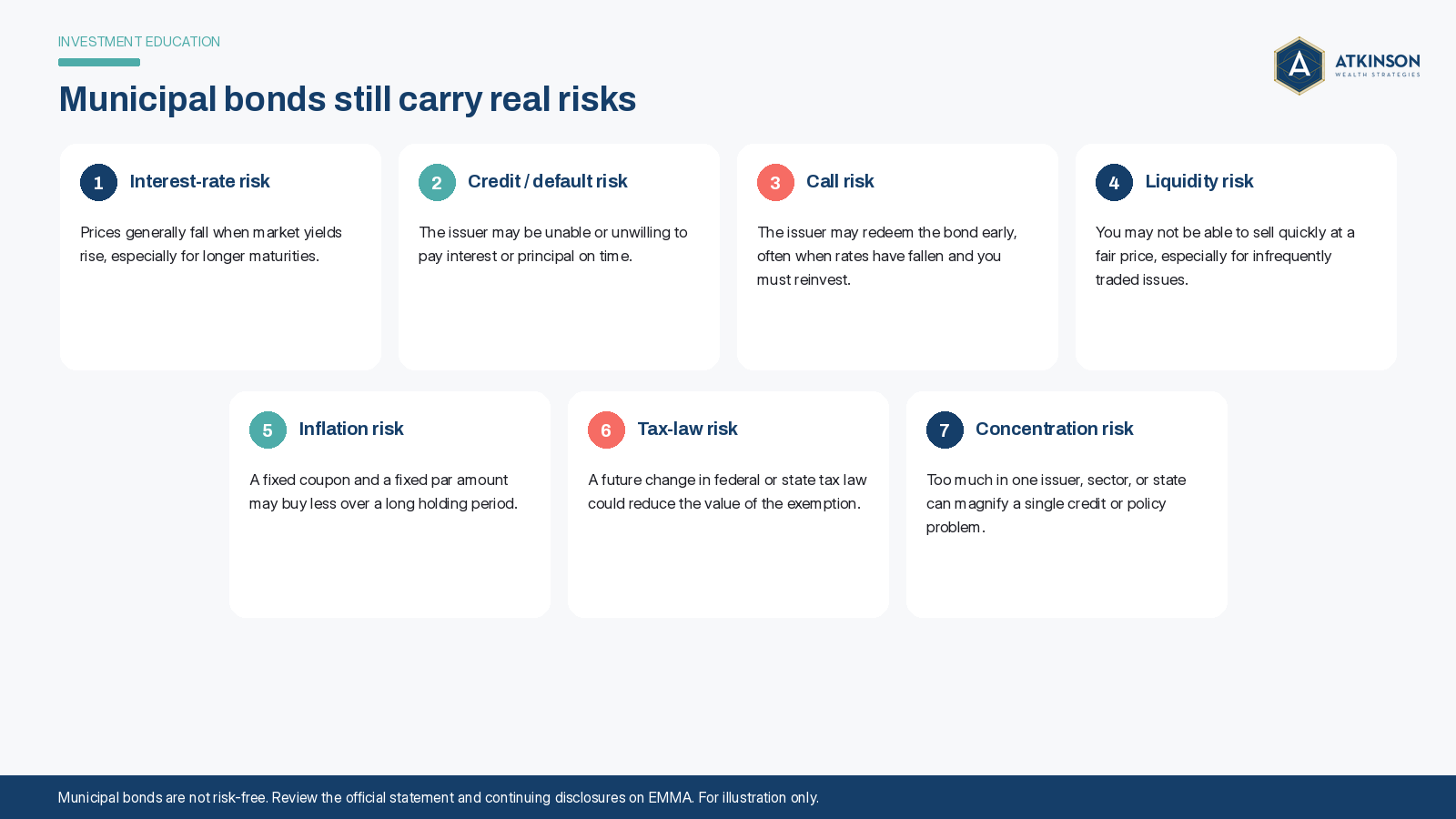
Every investment involves trade-offs, and munis are no exception. A tax break doesn’t protect you from loss. Let’s go through the main risks, using the MSRB’s list as our guide.
Interest-rate risk. Think of a seesaw. On one side are market interest rates. On the other are bond prices. When rates go up, prices of existing bonds generally go down, and the other way around.
Why? Say you own a bond paying 5.00%, and new bonds start paying 6.00%. Nobody will pay full price for your 5.00% bond when they can buy a new one paying more. So its price drops. Longer-term bonds usually feel this more.
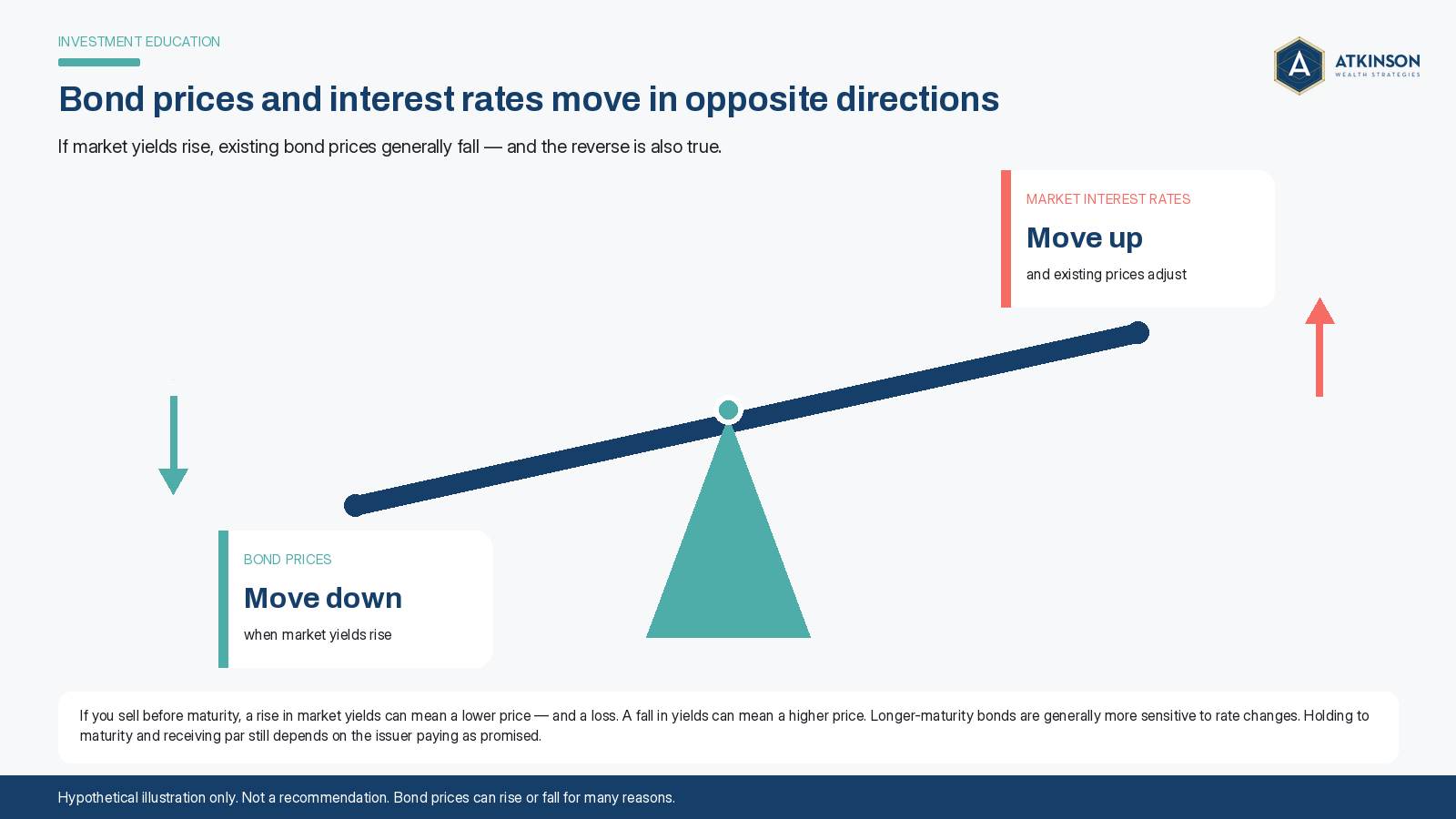
If you hold to maturity and the issuer pays as promised, you get par back. But if you need to sell early, you could get less than you paid.
Credit or default risk. This is the risk the issuer pays late or doesn’t pay at all. Municipal defaults are uncommon, but they do happen. Credit ratings can help, but ratings can change, and they aren’t guarantees.
Call risk. If your bond is called early, usually when rates have dropped, you lose that interest stream and may have to reinvest at a lower rate.
Liquidity risk. Many munis don’t trade often. If you need to sell in a hurry, you may not get the price you hoped for.
Inflation risk. Most munis pay a fixed amount. Over 10 or 20 years, rising prices can shrink what that money buys.
Tax-law risk. The value of the tax exemption depends on current law. If Congress or your state changes the rules, munis could become less valuable.
Concentration risk. Putting too much into one issuer, one industry, or one state ties your results to a single story. For example, a portfolio of only California munis depends heavily on California’s economy and tax policy.
What this means for you: Munis aren’t risk-free. Read the official statement on EMMA, understand what backs the bond, and think about how it fits with the rest of what you own.
Class Summary
Let’s review what we covered.
- A muni is an IOU from a public issuer. You lend money, typically earn interest, and get par back at maturity if the issuer pays as promised.
- GO bonds generally rely on taxing power. Revenue bonds rely on a specific source of money.
- Muni interest is often federally tax-exempt, but sales, discounts, the AMT, Social Security, and Medicare can still bring taxes into the picture.
- In Washington, there’s no state income tax on muni interest, though large long-term gains from selling bonds may face Washington’s capital gains tax. In California, in-state muni interest is generally exempt and out-of-state interest is generally taxed.
- Taxable-equivalent yield helps you compare, but risk and fit matter just as much.
If you’d like to talk through how municipal bonds might fit your goals, your tax picture, and the rest of your investments, you’re welcome to request a complimentary wealth review. It’s a no-obligation conversation focused on your Goals, Values, and Aspirations™.
You can also browse other guides in our Knowledge & Insights library, or see how we work with families through private wealth management.
Frequently Asked Questions
Are municipal bonds completely tax-free?
No. Interest on many munis is exempt from federal income tax, and sometimes from state tax too. But a gain when you sell is generally taxable, market discount can be taxed as ordinary income, some private activity bond interest counts for the AMT, and tax-exempt interest is included when figuring Social Security taxation and Medicare IRMAA. Some munis are taxable from the start.
What’s the difference between a general obligation bond and a revenue bond?
A general obligation bond is typically backed by the issuer’s taxing power and paid from its general funds. A revenue bond is typically paid only from a specific source of money, like utility bills or tolls. Some bonds mix features, so the official statement is the place to confirm what actually backs a bond.
Why does it matter to a Californian where a muni was issued?
California generally doesn’t tax interest on California municipal bonds but generally does tax interest on bonds from other states, even when that interest is federally tax-exempt. That changes the math when you compare yields.
Does Washington tax municipal bond interest?
No. Washington has no personal income tax, so muni interest from any state isn’t taxed as income there. Washington’s capital gains excise tax can apply to a long-term gain from selling bonds if you’re domiciled in Washington and your gains exceed the standard deduction. Interest itself isn’t a capital gain.
What is taxable-equivalent yield?
It’s the yield a taxable bond would need to pay to leave you with the same after-tax income as a tax-exempt bond. The basic formula is tax-exempt yield divided by (1 minus your tax rate). It’s a comparison tool, not a guarantee.
Where can I look up a specific municipal bond?
The MSRB’s free EMMA website, emma.msrb.org, has official statements, ongoing disclosures, and trade prices for municipal bonds. Your financial professional and the issuer’s investor page, if it has one, are other good places to look.
What is the de minimis rule for municipal bonds?
If you buy a tax-exempt municipal bond in the secondary market for less than its value on paper, the difference may be market discount, which is generally taxed as ordinary income when you sell or redeem the bond. Under the de minimis rule, if that discount is less than 0.25% of par multiplied by the number of full years left until maturity, it is generally treated as zero, and any gain is typically treated as a capital gain instead. Ask a tax professional about your specific calculation.
Does the tax exemption help inside an IRA or 401(k)?
Generally, the federal tax exemption on municipal bond interest adds little or no value inside an IRA or 401(k), because those accounts are already tax-advantaged (traditional or Roth). A taxable bond may be the more relevant comparison in those accounts. This is educational information, not a recommendation about which bonds to hold in any account.
Sources
- U.S. Securities and Exchange Commission, Investor.gov: Municipal Bonds – An Overview
- U.S. Securities and Exchange Commission, Investor.gov: Using EMMA
- Municipal Securities Rulemaking Board: Sources of Repayment
- Municipal Securities Rulemaking Board: Municipal Bond Investment Risks
- Municipal Securities Rulemaking Board: Build America Bonds and Other Tax Credit Bonds
- Municipal Securities Rulemaking Board, Electronic Municipal Market Access (EMMA)
- FINRA: The One-Minute Guide to Zero Coupon Bonds
- IRS Publication 550, Investment Income and Expenses
- IRS Instructions for Form 6251, Alternative Minimum Tax — Individuals
- IRS Publication 915, Social Security and Equivalent Railroad Retirement Benefits
- Social Security Administration Handbook § 2501, Modified Adjusted Gross Income
- Code of Federal Regulations, 20 CFR 418.1010 (IRMAA definitions, including modified adjusted gross income)
- Washington Department of Revenue: Frequently asked questions about Washington’s capital gains tax
- Washington Department of Revenue: Do you owe capital gains tax?
- Washington Department of Revenue special notice, June 30, 2025: New tiered rates for Washington’s capital gains tax
- California Franchise Tax Board, 2025 California Tax Rate Schedules
- California Franchise Tax Board Publication 1001 (2025), Supplemental Guidelines to California Adjustments
- California Franchise Tax Board, 2026 Form 540-ES instructions
Important information. This material is for informational purposes only and is not a recommendation to buy or sell any security or to use any particular tax strategy. Municipal bonds can lose value, including the loss of principal, and an issuer can default. Interest is not guaranteed. This material is for general information only and is not intended to provide specific advice or recommendations for any individual, including individualized tax, legal, or investment advice. LPL Financial does not provide tax or legal advice. Please consult your tax and/or legal professional regarding your specific situation. All investing involves risk, including possible loss of principal. No strategy assures success or protects against loss. Securities and advisory services offered through LPL Financial, a registered investment adviser, Member FINRA/SIPC.