
Key takeaways
- On November 12, 2026, the IRS raised the 2027 employee 401(k) deferral limit to $25,500 (up $1,000) and the total limit on all contributions to $75,000 (up $3,000).
- Microsoft's official benefits pages describe a 50% match on pre-tax and Roth contributions up to the IRS basic limit. If that formula carries into 2027, a full $25,500 deferral would be matched with $12,750. Microsoft had not posted its 2027 figures as of this writing.
- Catch-up contributions are not matched at Microsoft, so the after-tax room in the illustration below is about the same for employees under and over 50.
- In a hypothetical illustration on a $250,000 base salary, $75,000 − $25,500 − $12,750 leaves about $36,750 of after-tax room. The plan lets you convert new after-tax contributions to Roth automatically each day.
- If your 2026 FICA wages were over $155,000 and you'll be 50 or older in 2027, your catch-up contributions generally must go in as Roth. Your plan documents control, and this isn't tax advice.
Updated for the 2027 plan year. This is general educational information based on publicly available Microsoft plan information and IRS guidance as of November 2026. It isn’t tax, legal, or individualized advice, and your official plan documents (the Summary Plan Description and plan document) control.
On November 12, 2026, the IRS announced the 401(k) limits for 2027 in News Release IR-2026-136. For Microsoft employees, the new numbers change three things in your 401(k) at once: the most you can put in from your paycheck, the largest match Microsoft can add, and the room left over for after-tax savings.
Picture your 401(k) as a building with two ceilings. The lower ceiling is what you can contribute from your paycheck. The higher ceiling is the total that can go in from every source. For 2027, the IRS raised both. Here’s what that may mean inside Microsoft’s plan specifically.
What Changed for 2027
| Limit | 2026 | 2027 | Change |
|---|---|---|---|
| Your pre-tax + Roth contributions | $24,500 | $25,500 | +$1,000 |
| Age 50+ catch-up | $8,000 | $8,500 | +$500 |
| Ages 60–63 catch-up | $11,250 | $11,750 | +$500 |
| Total from all sources (the “415(c) limit”) | $72,000 | $75,000 | +$3,000 |
| 2026 wages that trigger Roth-only catch-up in 2027 | — | $155,000 | new threshold |
Source: IRS IR-2026-136 and Notice 2026-66.
The total limit grew by $3,000 while your own limit grew by $1,000. At Microsoft, that gap is where the after-tax opportunity gets slightly larger, as you’ll see below.
Microsoft’s Match Under the New Limits
Microsoft’s contribution options page says Microsoft matches 50 cents for every dollar you put into the pre-tax and/or Roth part of the plan, up to the IRS basic limit. For 2026, that meant a $24,500 contribution earned a $12,250 match.
Apply the same formula to 2027 and a full $25,500 contribution would earn a $12,750 match. That is our math on the new IRS limit. As of this writing, Microsoft’s site still shows 2026 figures, so look for the official 2027 number in Fidelity NetBenefits. Microsoft notes that it can change the match, and its plan documents govern.
A few Microsoft-specific details shape how the match works in practice:
- No match on catch-up. Microsoft’s site says catch-up contributions are not matched. The extra $8,500 (or $11,750 at ages 60–63) is your money only.
- No match on after-tax money. Only pre-tax and Roth contributions count.
- Vested from day one. Microsoft says you are 100% vested from the beginning.
- Matched each paycheck. The match is added each pay period as you contribute, and payroll stops your pre-tax/Roth contributions when you reach the IRS limit. The SPD explains that once you reach the limit, you will have received the maximum match for the year.
- Your September bonus counts. Microsoft treats annual review bonuses as eligible pay, so your contribution percentage is also taken from your bonus check. Stock awards are not eligible pay.
Hypothetical illustration: On a $250,000 base salary (not including bonuses, RSU vests, or other pay), $25,500 is about 10.2% of base. An employee who wanted to reach the full $25,500 from base pay alone would need a rate of at least that much. Because the bonus also counts as eligible pay, some people reach the limit sooner. Payroll would then stop contributions automatically.
Hypothetical illustration only. It uses the stated assumptions, including a $250,000 base salary, and doesn’t reflect any actual employee. Your results will vary.
Plan features can change, so please confirm your current match details in your plan’s official documents or with the plan administrator through Fidelity NetBenefits or Microsoft’s U.S. benefits site.
The After-Tax Feature and Daily Roth Conversion
In short, a mega backdoor Roth means making after-tax contributions to a 401(k) and then converting them to Roth. For the full explanation, see how a mega backdoor Roth works.
Microsoft’s plan offers both pieces, and they’re spelled out more clearly than at many employers:
- After-tax (non-Roth) contributions of 1% to 65% of pay per period, with a published annual dollar cap. The cap was $35,250 for 2026. These contributions are not matched.
- Automatic daily Roth In-Plan Conversion. According to Microsoft’s Roth conversions page and SPD, choosing “Convert My After-Tax Contributions” in NetBenefits tells Fidelity to convert new after-tax payroll contributions to Roth on the same day they arrive. It’s a one-time setting.
- Older balances aren’t swept automatically. After-tax money contributed before you made the election needs a separate conversion request through Fidelity.
- In-service options. The SPD also allows withdrawals of after-tax balances while you’re still employed, which some people roll to a Roth IRA instead of converting inside the plan.
Before you rely on these features, confirm how after-tax contributions and Roth conversions work in your plan’s official documents or with the plan administrator through Fidelity NetBenefits or Microsoft’s U.S. benefits site, since plan features can change.
How Much After-Tax Room Microsoft Employees May Have
After-tax room = $75,000 − your pre-tax/Roth contributions (not catch-up) − Microsoft’s match
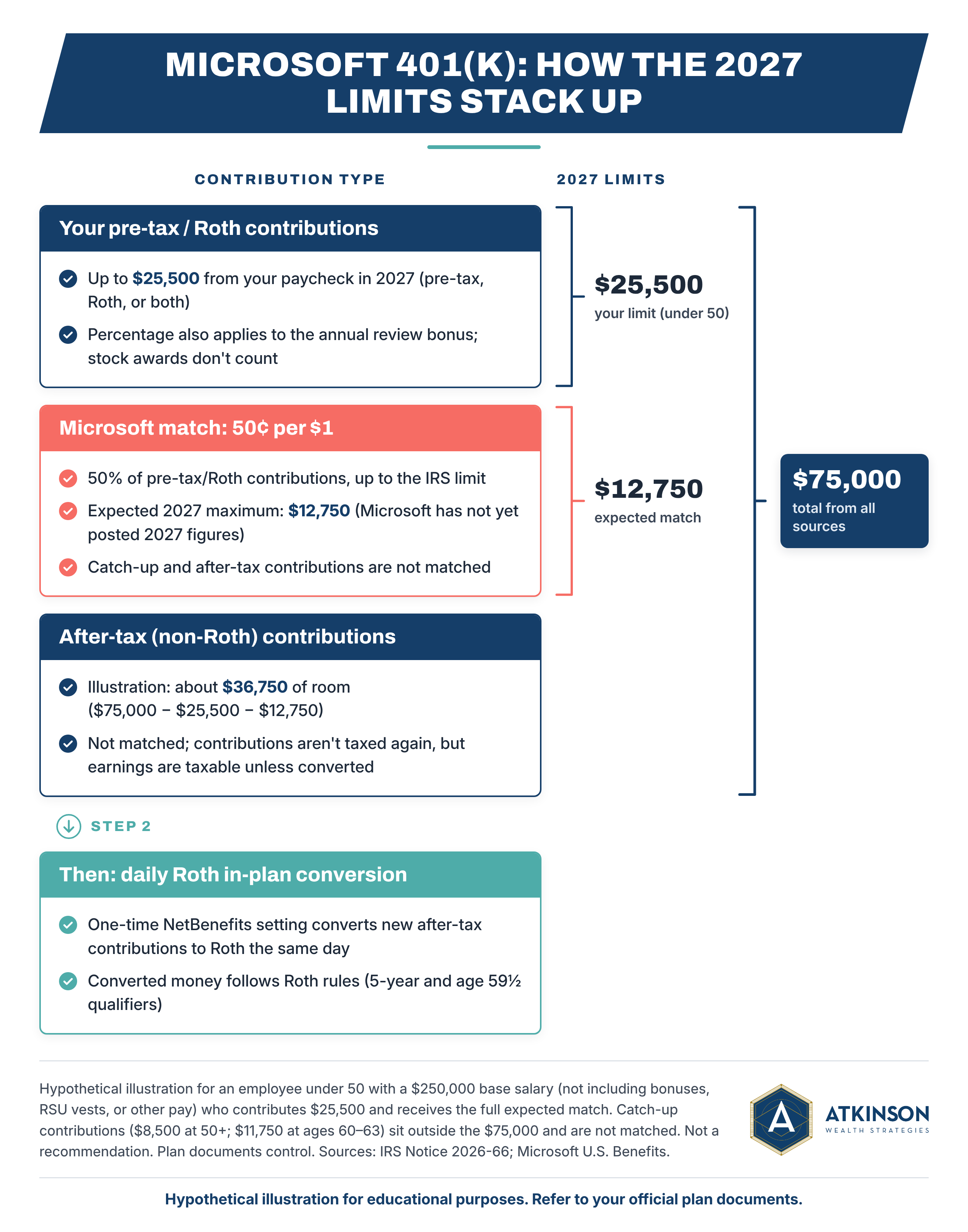
Hypothetical illustration (2027): Assume a $250,000 base salary (not including bonuses, RSU vests, or other pay), the full $25,500 contributed, the full expected match, no other employer contributions, no other 401(k) that year, and no limits from plan testing.
| Under 50 | 50–59 or 64+ | 60–63 | |
|---|---|---|---|
| Total limit (415(c)) | $75,000 | $75,000 | $75,000 |
| Your pre-tax/Roth contributions | − $25,500 | − $25,500 | − $25,500 |
| Expected Microsoft match | − $12,750 | − $12,750 | − $12,750 |
| Possible after-tax room | about $36,750 | about $36,750 | about $36,750 |
| Catch-up (sits outside the $75,000) | — | + $8,500 | + $11,750 |
Because Microsoft doesn’t match catch-up, the after-tax room stays about the same at every age. Microsoft’s 2026 after-tax cap ($35,250) followed this exact math, so a 2027 cap of about $36,750 is the expected figure, not yet confirmed.
At this salary, the 65% election limit is unlikely to be what stops you. Filling all three buckets from base pay alone would take about $62,250 of the $250,000 base, roughly 25%. Cash flow is usually the real question.
Hypothetical illustration only. It uses the stated assumptions, including a $250,000 base salary, and doesn’t reflect any actual employee. Your results will vary.
What to Think Through Before You Set 2027 Elections
Cash flow. Putting $62,250 or more into a 401(k) is a big commitment. Many Microsoft employees also have RSUs vesting and may be in the ESPP. It helps to look at your take-home pay, emergency reserves, and near-term goals together before raising your after-tax rate. Our overviews of how RSUs work and how an ESPP works cover those pieces.
The Roth catch-up rule. If you’ll be 50 or older in 2027 and your 2026 FICA wages from Microsoft (box 3 of your W-2) were over $155,000, your 2027 catch-up contributions generally must go in as Roth. On a $250,000 base, that rule would typically apply. Microsoft says the switch happens automatically once you reach the regular limit. Some older passages on Microsoft’s site still show earlier thresholds, so rely on the IRS figure.
Conversion timing. Your after-tax contributions were already taxed, so converting them generally isn’t taxed again. Any earnings before conversion generally are taxable. The daily automatic setting keeps that window short. An older after-tax balance with growth may create a tax bill when converted, which is worth estimating with a tax professional first. Because taxes may apply to earnings when you convert, and qualified Roth withdrawals have their own requirements, it’s wise to talk with a tax professional before converting.
Roth withdrawal rules. Qualified withdrawals from a Roth 401(k) are generally tax-free. To be qualified, the Roth account must be held at least five tax years and you must be 59½ or older, disabled, or deceased. Other withdrawals may be taxable and could face a 10% additional tax on earnings.
Plan rules. Microsoft’s SPD notes that contributions from highly compensated employees may be limited by IRS testing. Plan terms can change, and the official plan documents control.
Your 2027 Microsoft 401(k) Checklist
- Watch NetBenefits for Microsoft’s official 2027 match and after-tax figures.
- Check that your pre-tax/Roth rate gets you to $25,500 the way you intend, including your September bonus.
- If after-tax savings fit your budget, confirm “Convert My After-Tax Contributions” is turned on.
- Look for any older after-tax balance that was never converted.
- If you’ll be 50+, check whether the Roth catch-up rule applies to you.
For more on the full picture of your benefits, see our planning for Microsoft employees page.
If you work at Microsoft and would like to see how the 2027 limits fit your own situation, you’re welcome to request a complimentary wealth review. It’s a no-obligation conversation about your Goals, Values, Aspirations™, and about how your 401(k) choices, including after-tax savings, might fit with your RSUs, ESPP, taxes, and the rest of your financial life.
Related reading: 2027 Meta 401(k) Limits: Match and Mega Backdoor Roth.
Important information. The examples in this article are hypothetical and for illustration only. IRS limits and plan rules are subject to change. The Microsoft name is used only to identify the employer plan discussed. Atkinson Wealth Strategies is not affiliated with, or endorsed by, Microsoft. Please refer to your official plan documents for the terms that apply to you.
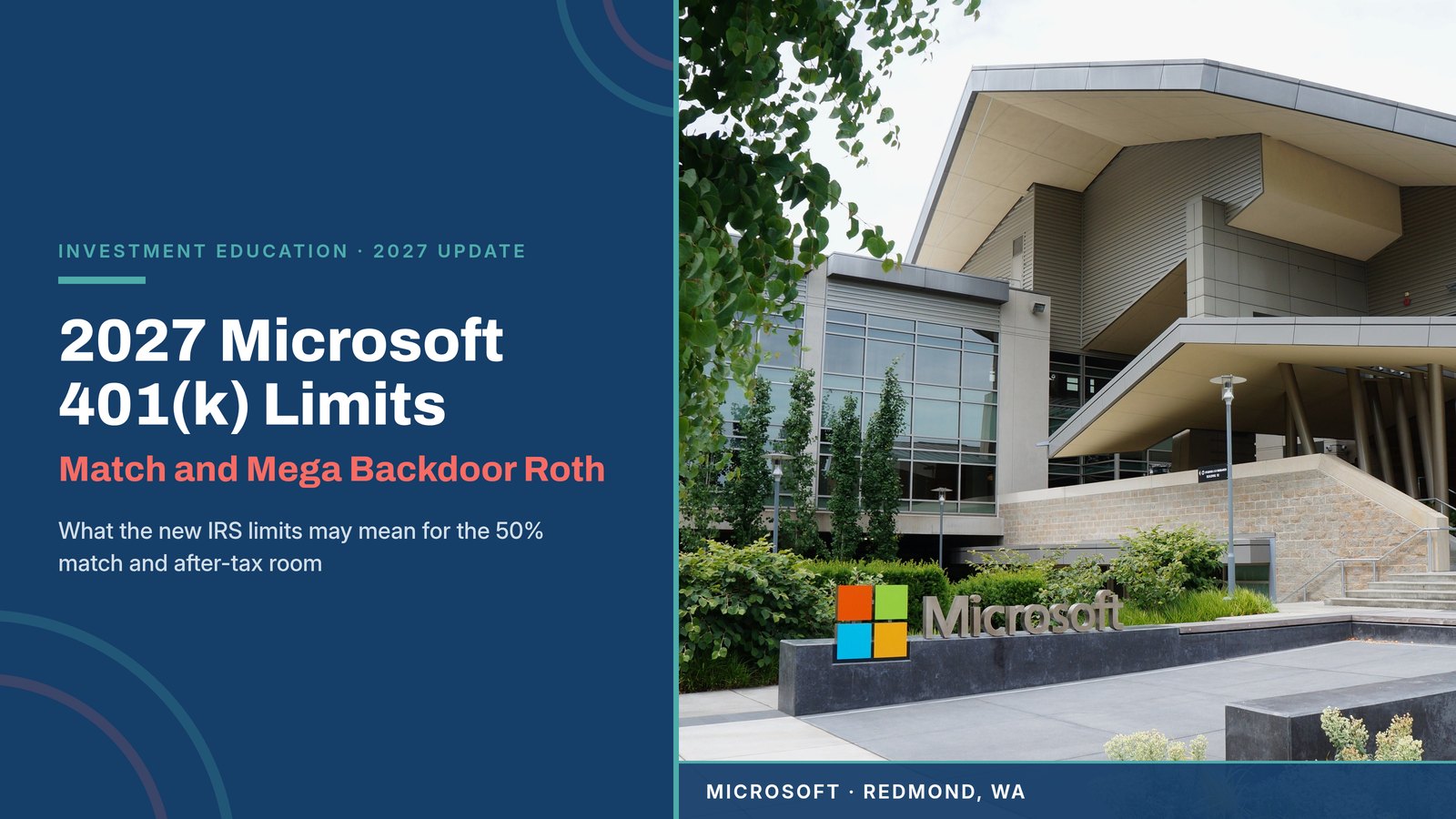
Featured image photo: Building 92 of the Microsoft Redmond campus, by Jiaqian AirplaneFan, via Wikimedia Commons, licensed under CC BY 3.0 (cropped; text added).
Sources
- IRS News Release IR-2026-136, "401(k) limit increases to $25,500 for 2027, IRA limit remains $7,500" (Nov. 12, 2026)
- IRS Notice 2026-66, 2027 Amounts Relating to Retirement Plans and IRAs
- IRS, Retirement Plans FAQs on Designated Roth Accounts
- IRS, Rollovers of After-Tax Contributions in Retirement Plans
- Microsoft U.S. Benefits, Contribution Options
- Microsoft U.S. Benefits, 401(k) Savings Plan
- Microsoft U.S. Benefits, Roth Conversions
- Microsoft U.S. Benefits, Changes to the Microsoft 401(k) effective Jan. 1, 2026
- Microsoft Corporation Savings Plus 401(k) Plan Summary Plan Description (Jan. 1, 2025)
Frequently asked questions
How much will Microsoft match if I max out my 401(k) in 2027?
Microsoft's published formula is 50% of pre-tax and Roth contributions up to the IRS basic limit. If the formula is unchanged, contributing the full $25,500 in 2027 would earn a $12,750 match. As of this writing, Microsoft had not posted 2027 figures, so confirm the amount in Fidelity NetBenefits.
Does Microsoft match catch-up contributions?
No. Microsoft's contribution options page says catch-up contributions are not matched. Plan terms can change, and the official plan documents control.
Can I automatically convert after-tax contributions to Roth in the Microsoft 401(k)?
According to Microsoft's benefits site and Summary Plan Description, yes. Choosing "Convert My After-Tax Contributions" in NetBenefits converts new after-tax payroll contributions to Roth on the same day. After-tax balances from before the election need a separate request through Fidelity.
If my 2026 wages were over $155,000, do my 2027 catch-up contributions have to be Roth?
Generally yes, under the SECURE 2.0 rule and IRS Notice 2026-66. The test uses your prior-year FICA wages from your employer. It applies only to catch-up contributions, and your regular $25,500 can still be pre-tax and/or Roth. A tax professional can help you understand how it affects you.