

Key takeaways
- On November 12, 2026, the IRS raised the 2027 employee 401(k) deferral limit to $25,500 (up $1,000) and the total limit on all contributions to $75,000 (up $3,000).
- Apple matches your contributions on up to 6% of salary at a rate that grows with service: 50% for 0 to 2 years (a maximum of 3% of salary), 75% for 2 to 5 years (4.5%), and 100% for 5 or more years (6%). The match is immediately vested.
- Because Apple's match grows with tenure, your after-tax room shrinks as your match grows. In a hypothetical illustration on a $250,000 base salary, the room is about $42,000, $38,250, or $34,500 depending on years of service.
- Apple's plan also caps after-tax contributions at 20% of eligible pay. On a $250,000 base, that's $50,000, so the IRS limit is what binds in the examples. How after-tax money is converted to Roth is worth confirming in NetBenefits.
- If your 2026 FICA wages were over $155,000 and you'll be 50 or older in 2027, your catch-up contributions generally must go in as Roth. Your plan documents control, and this isn't tax advice.
Updated for the 2027 plan year. This is general educational information based on publicly available Apple plan information and IRS guidance as of November 2026. It isn’t tax, legal, or individualized advice, and your official plan documents (the Summary Plan Description and plan document) control.
On November 12, 2026, the IRS announced the 401(k) limits for 2027 in News Release IR-2026-136. If you work at Apple, the new limits interact with a match that works differently from many large tech companies. Apple’s match depends on how long you’ve worked there and how much you earn, not a fixed dollar cap.
That means two Apple colleagues in the same meeting can have very different numbers. Think of a recipe that scales with the size of the pan: the steps are the same, but the amounts change. Here’s how the 2027 limits may play out at each stage of an Apple career.
What Changed for 2027
| Limit | 2026 | 2027 | Change |
|---|---|---|---|
| Your pre-tax + Roth contributions | $24,500 | $25,500 | +$1,000 |
| Age 50+ catch-up | $8,000 | $8,500 | +$500 |
| Ages 60–63 catch-up | $11,250 | $11,750 | +$500 |
| Total from all sources (the “415(c) limit”) | $72,000 | $75,000 | +$3,000 |
| Pay a plan can count (401(a)(17)) | $360,000 | $375,000 | +$15,000 |
| 2026 wages that trigger Roth-only catch-up in 2027 | — | $155,000 | new threshold |
Source: IRS IR-2026-136 and Notice 2026-66.
That pay limit gets little attention at most companies, but it matters at Apple. Because Apple’s match is a percentage of pay, pay above $375,000 generally can’t be counted toward it.
Apple’s Match: It Grows With Your Years of Service
Here’s how Apple’s match works. Apple matches your regular pre-tax and/or Roth contributions on up to 6% of your salary, at a rate based on your years of service:
| Years of service | Apple matches | Maximum match |
|---|---|---|
| 0 to 2 years | 50% of contributions up to 6% of salary | 3% of salary |
| 2 to 5 years | 75% of contributions up to 6% of salary | 4.5% of salary |
| 5 or more years | 100% of contributions up to 6% of salary | 6% of salary |
The plan’s most recent public filing (the Form 5500 auditor’s report for the 2025 plan year) adds a few details:
- Your rate is based on your service as of each payroll date, so it may step up right after your 2- and 5-year anniversaries.
- You’re immediately vested in your entire account, including Apple’s match.
- New employees are automatically enrolled at 3% of pay, rising 1% a year to 6%, unless they choose otherwise.
- The match is described as applying to regular contributions, which suggests catch-up contributions may not be matched. Your plan summary would confirm that.
Hypothetical illustration: On a $250,000 base salary (not including bonuses, RSU vests, or other pay), 6% is $15,000. To receive the full match at any tenure level, an employee would generally need to contribute at least that much. They could still contribute up to the $25,500 IRS limit.
Hypothetical illustration only. It uses the stated assumptions, including a $250,000 base salary, and doesn’t reflect any actual employee. Your results will vary.
Plan features can change, so please confirm your current match details in your plan’s official documents or with the plan administrator through Fidelity NetBenefits.
The After-Tax Feature at Apple
In short, a mega backdoor Roth means making after-tax contributions to a 401(k) and then converting them to Roth. For the full explanation, see how a mega backdoor Roth works.
As of the latest plan filing (2025), Apple’s plan allowed after-tax contributions of up to 20% of eligible pay. That’s a second cap that many plans don’t have.
How after-tax money becomes Roth money at Apple is less clear from public sources. Some materials describe an automatic daily conversion setting in NetBenefits. Others describe a conversion you request on a schedule, such as every two weeks. Check Fidelity NetBenefits or your plan summary for how the conversion works in your account today.
Before you rely on these features, confirm how after-tax contributions and Roth conversions work in your plan’s official documents or with the plan administrator through Fidelity NetBenefits, since plan features can change.
How Much After-Tax Room Apple Employees May Have
At Apple, you check two limits and use the smaller one:
- The IRS room: $75,000 − your pre-tax/Roth contributions (not catch-up) − Apple’s match
- Apple’s plan cap: 20% of eligible pay
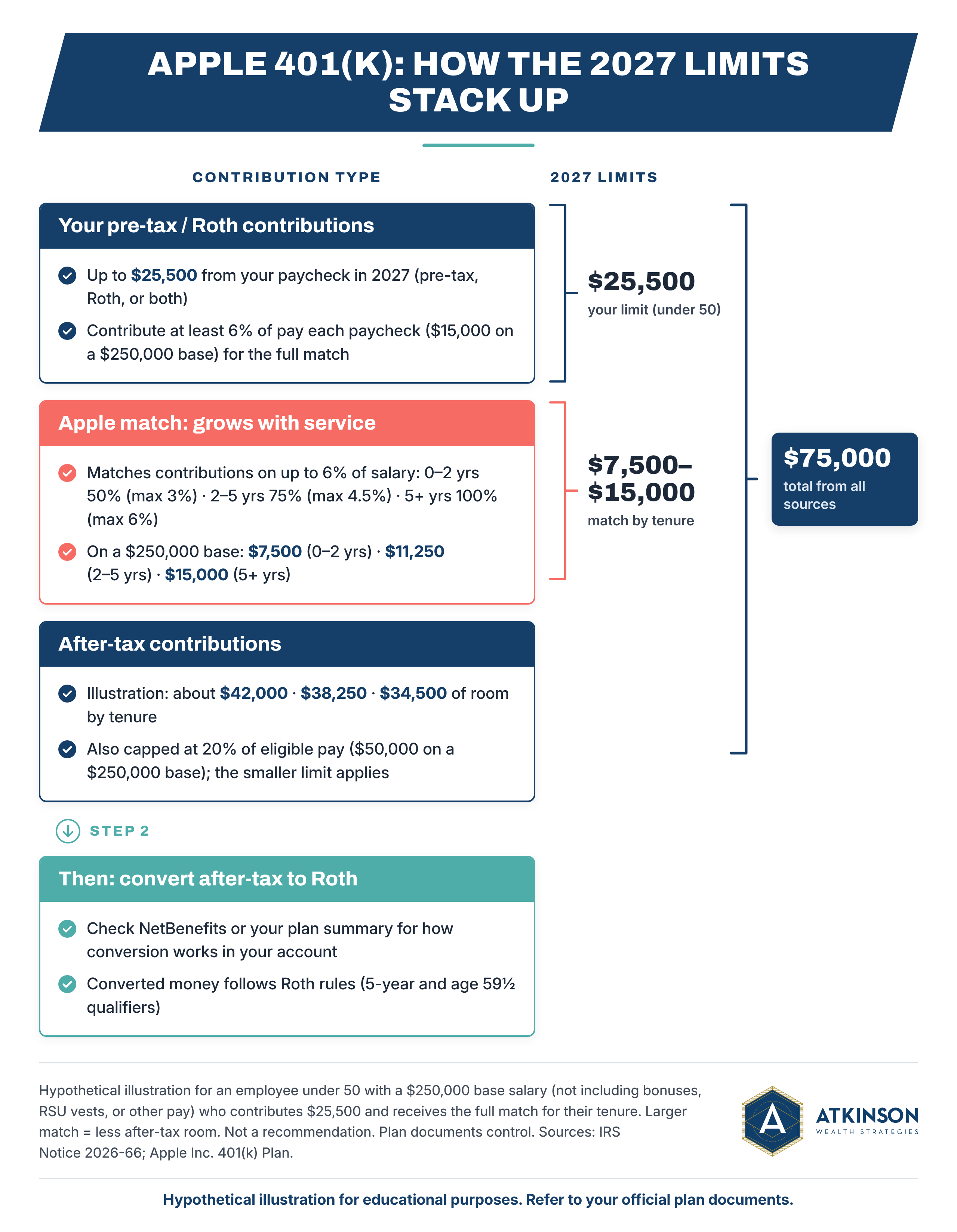
Hypothetical illustration (2027): Assume an employee under 50 with a $250,000 base salary (not including bonuses, RSU vests, or other pay) contributes the full $25,500, receives the full match for their tenure, has no other employer contributions, has no other 401(k) that year, and isn’t limited by plan testing. On this base, the 20% cap is $50,000, so the IRS limit is the smaller one in every row:
| Years of service | Apple match (6% of $250,000 × rate) | IRS room ($75,000 − $25,500 − match) | 20% plan cap | Possible after-tax room |
|---|---|---|---|---|
| 0 to 2 (50%) | $7,500 | $42,000 | $50,000 | about $42,000 |
| 2 to 5 (75%) | $11,250 | $38,250 | $50,000 | about $38,250 |
| 5 or more (100%) | $15,000 | $34,500 | $50,000 | about $34,500 |
Notice the pattern: the longer you’ve been at Apple, the smaller your after-tax room. A bigger match is valuable, and it also uses more of the $75,000 ceiling. A newer employee may have about $7,500 more after-tax room than a colleague with five years of service at the same base pay.
If eligible pay includes more than base salary, such as bonuses, both the match and the 20% cap could be larger, up to the $375,000 pay limit. That’s why these examples use base pay only.
Hypothetical illustration only. It uses the stated assumptions, including a $250,000 base salary, and doesn’t reflect any actual employee. Your results will vary.
What to Think Through Before You Set 2027 Elections
Each paycheck is matched on its own. According to the filing, the match is figured per pay period on up to 6% of that period’s pay. If you reach $25,500 before year-end and your contributions stop, later paychecks may get no match. We didn’t find a public description of a year-end “true-up,” so it’s worth asking Fidelity before you front-load.
Watch your anniversaries. Because your rate is set as of each payroll date, a 2- or 5-year anniversary partway through 2027 means your match, and your after-tax room, may change mid-year.
Cash flow, RSUs, and the ESPP. Many Apple employees also have RSUs vesting and may participate in the ESPP. Look at take-home pay, emergency reserves, and goals together before raising after-tax contributions. Our overviews of how RSUs work and how an ESPP works cover those pieces.
The Roth catch-up rule. If you’ll be 50 or older in 2027 and your 2026 FICA wages from Apple were over $155,000, your 2027 catch-up contributions generally must go in as Roth. On a $250,000 base, that would typically apply.
Conversion timing. After-tax contributions were already taxed, so converting them generally isn’t taxed again. Earnings before conversion generally are taxable. The shorter the gap between contribution and conversion, the less taxable growth builds up. Because taxes may apply to earnings when you convert, and qualified Roth withdrawals have their own requirements, it’s wise to talk with a tax professional before converting.
Roth withdrawal rules. Qualified withdrawals from a Roth 401(k) are generally tax-free. To be qualified, the Roth account must be held at least five tax years and you must be 59½ or older, disabled, or deceased. Other withdrawals may be taxable and could face a 10% additional tax on earnings.
Plan rules. After-tax and match amounts are subject to IRS testing, which may limit highly compensated employees. Plan terms can change, and the official plan documents control.
Your 2027 Apple 401(k) Checklist
- Confirm your service tier and when your next 2- or 5-year anniversary falls.
- Make sure you’re contributing at least 6% of pay each paycheck if you want the full match.
- Check both limits on after-tax money: the IRS room and the 20% plan cap.
- Confirm how after-tax contributions are converted to Roth in your NetBenefits account.
- Ask whether the plan offers a year-end true-up before you front-load.
- Review whether the Roth catch-up rule applies to you.
For a wider look at your benefits, see our page on planning for Apple employees.
If you work at Apple and would like to see how the 2027 limits fit your own situation, you’re welcome to request a complimentary wealth review. It’s a no-obligation conversation about your Goals, Values, Aspirations™, and about how your 401(k) choices, including after-tax savings at your tenure level, might fit with your RSUs, ESPP, taxes, and the rest of your financial life.
Related reading: 2027 Meta 401(k) Limits: Match and Mega Backdoor Roth and 2027 Microsoft 401(k) Limits: Match and Mega Backdoor Roth.
Important information. The examples in this article are hypothetical and for illustration only. IRS limits and plan rules are subject to change. The Apple name is used only to identify the employer plan discussed. Atkinson Wealth Strategies is not affiliated with, or endorsed by, Apple. Please refer to your official plan documents for the terms that apply to you.
Featured image photo: aerial view of Apple Park, Cupertino, California, by Zetong Li, via Pexels, used under the Pexels License (cropped; text added).
Sources
- IRS News Release IR-2026-136, "401(k) limit increases to $25,500 for 2027, IRA limit remains $7,500" (Nov. 12, 2026)
- IRS Notice 2026-66, 2027 Amounts Relating to Retirement Plans and IRAs
- IRS, Retirement Plans FAQs on Designated Roth Accounts
- IRS, Rollovers of After-Tax Contributions in Retirement Plans
- Apple Inc. 401(k) Plan, Form 5500 for plan year 2025, independent auditor's report (U.S. Department of Labor EFAST2 filing search)
Frequently asked questions
How does Apple's 401(k) match change with years of service under the 2027 limits?
Apple matches pre-tax and Roth contributions on up to 6% of salary at a rate based on years of service: 50% for 0 to 2 years (a maximum of 3% of salary), 75% for 2 to 5 years (4.5%), and 100% for 5 or more years (6%). On a hypothetical $250,000 base salary, that's a maximum match of $7,500, $11,250, or $15,000.
How do I figure after-tax room at Apple, including the 20% of pay cap?
Start with $75,000, subtract your pre-tax/Roth contributions (not catch-up) and Apple's match, then compare the result with 20% of eligible pay. Your practical limit is generally the smaller of the two.
If I have been at Apple longer, why is my mega backdoor Roth room smaller?
A larger match uses more of the $75,000 total limit, which leaves less space for after-tax contributions. At the same pay, a five-year employee generally has less after-tax room than a newer colleague.
If my 2026 wages were over $155,000, do my 2027 catch-up contributions have to be Roth?
Generally yes, under the SECURE 2.0 rule and IRS Notice 2026-66. The test uses prior-year FICA wages from your employer and applies only to catch-up contributions. A tax professional can help you understand how it affects you.